
Sewer Camera Inspection Services
Sewer line locating in Sterling Heights, MI
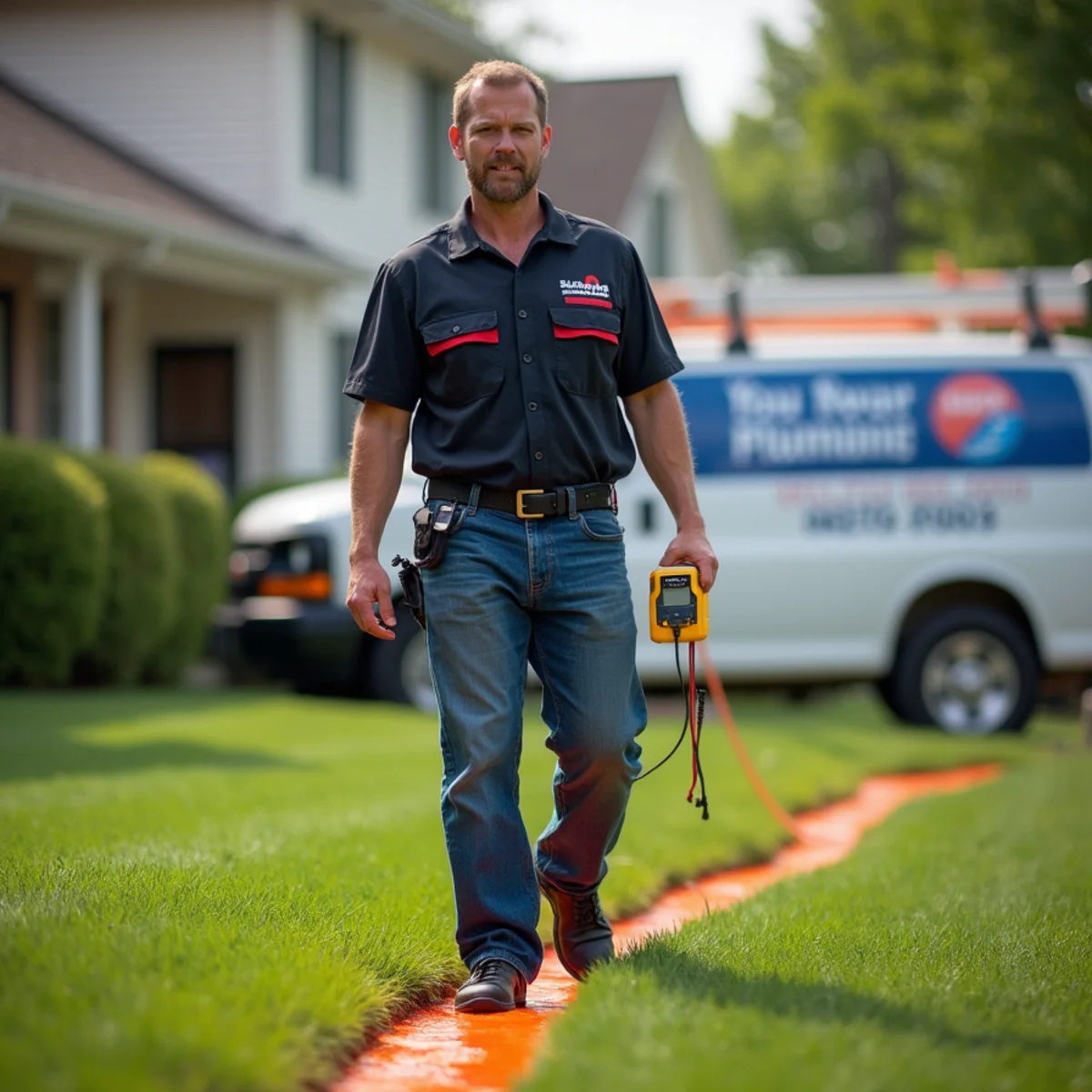
Sewer line locating in Sterling Heights uses a transmitting sonde built into the camera head and a handheld surface receiver to trace a private sewer lateral's path and estimate its depth, so you know where to dig before a shovel ever touches the ground.
- Recorded HD video
- Same-day report
- Licensed & insured
That matters most on properties where a wrong guess costs the most: long private laterals running well past a typical city-lot distance, rural lots being converted from a failing septic system to municipal sewer, and any yard where a mature tree, a paver patio, or a finished addition sits above the line. Instead of trenching the full lateral to find one bad joint, locating puts a surface mark and a depth estimate on the exact spot that needs attention.
We typically run locating during or right after a camera inspection, tracking the sonde to a defect, an endpoint, or a specific point you need marked for planning. It's an honest tool, not a survey — the mark is an approximate surface reading, not a legal boundary or a guaranteed excavation point — and it never replaces calling 811 before anyone digs.
When you need locating and depth
Locating earns its cost any time excavation, site planning, or a long unknown run is involved:
- A repair or replacement is coming and you want the dig limited to one spot, not the whole yard
- You're planning an addition, a pool, a patio, landscaping, or grading anywhere near the lateral's path
- A camera inspection found a crack, break, or root intrusion and you need its surface position marked
- You have a long private or rural lateral running well past a typical 50-100 ft city-lot connection
- You're converting a septic system to municipal sewer and need the new run mapped and its depth confirmed
- A contractor or excavator wants the line marked before mobilizing equipment or scheduling a crew
- You're comparing repair bids and want every contractor digging from the same verified reference point
- You want the line's path confirmed before calling 811 and finalizing an excavation plan
How sewer line locating works
Locating rides along with the camera — here's the sequence from access to marked ground:
- 1
Confirm access & the target
We confirm cleanout access and agree on what needs locating — a defect from a prior camera inspection, an endpoint, or a specific point along a long or unknown run.
- 2
Camera to the point of interest
We run the camera to the defect, fitting, or endpoint we need located, recording the line's condition along the way.
- 3
Activate the sonde
A transmitting sonde built into the camera head emits a signal that a handheld surface receiver can track from above ground.
- 4
Trace the path
We walk the receiver across the property, following the signal to trace the lateral's actual route — the step that matters most on long or rural runs where the path isn't obvious from the surface.
- 5
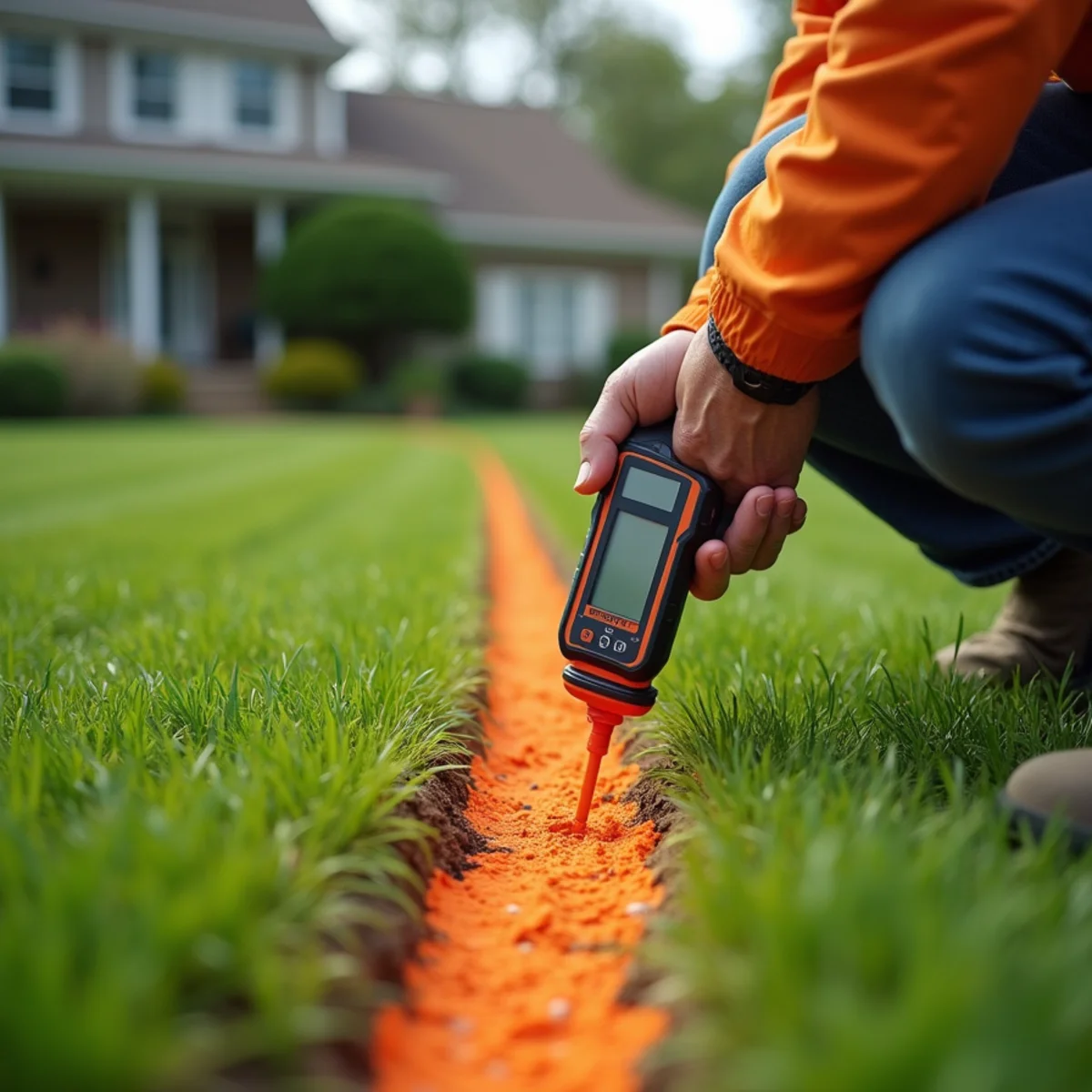
Mark & estimate depth
We mark the approximate surface location and estimate depth at that point, so a repair crew or excavator knows roughly what to expect before breaking ground.
- 6
Hand off the plan
You get the marked location, the estimated depth, and — when paired with a camera inspection — the recorded footage to hand a contractor or compare bids against.
Locating pricing factors
Locating is usually added to a camera inspection or booked on its own when a defect's position or a full lateral route is needed. Cost depends on:
- Whether locating is bundled with a camera inspection or booked as a standalone visit
- Line length — a long private or rural lateral takes more time to trace than a typical 50-100 ft city-lot run
- How many points along the line need to be marked, not just one
- Site conditions that affect signal tracing — burial depth, soil type, and nearby utilities or buried metal
- Whether the camera has to clear debris or travel a long run before the sonde can be activated at the target
- Access — a missing, buried, or damaged cleanout can add time before locating even starts
What's included with a sewer line locating visit
Every locating visit is built around one goal: giving you a real-world mark and depth you can hand to a contractor, not a guess. Depending on whether locating is standalone or paired with a camera inspection, you get:
- Camera run to the defect, fitting, or endpoint you need located
- Sonde-based trace of the lateral's path along the surface
- A physical surface mark at the located point (paint or flag, condition-dependent)
- An estimated depth reading at the marked point
- Still images and, when paired with an inspection, the recorded video
- A plain-English summary of what was located, where, and at what estimated depth
Long private laterals, rural lots & septic-to-sewer runs
A lateral under a standard subdivision lot is short, shallow, and predictable. That's not what we're mapping on the larger, more rural-feeling parcels in places like Washington Township, Ray Township, Bruce Township, and parts of Macomb Township, where a run to the road can stretch well past a typical city-lot distance or feed a system only recently converted from septic. On those properties, guessing at the path before digging is the difference between a one-day repair and a week of exploratory trenching. We cover the full method in our guide on how sewer line locating works.
Why signal tracing gets harder underground
The sonde signal doesn't travel through soil the same way everywhere. Deeper burial, dense clay, saturated ground after rain, and nearby buried metal — fencing, old gas lines, rebar — can weaken or distort the receiver's reading. On a long rural run, we may need multiple trace points rather than one shot from the house to the street. When conditions work against us, we'll say so plainly rather than hand you a confident-sounding mark we don't trust.
An approximate locate is not a surveyed mark
We say this on every job because it matters: a sonde locate is a strong, practical estimate of the line's surface position and depth — not a licensed land survey and not a legally guaranteed dig point. It's accurate enough to turn a whole-yard excavation into a targeted one, and that's exactly what it's for. But treat the mark as a well-informed starting point for a contractor's dig, not a guaranteed inch-perfect coordinate, especially on a long or deep run.
Call 811 before you dig
Our sonde locate marks the sewer lateral — it does not identify gas, electric, water, or communication lines. Michigan law requires calling 811 (or filing online) at least a few business days before any excavation so public utilities can be marked separately. Locate the sewer line, then call 811, then dig.
From a locate to a targeted dig
Locating is almost always one step in a bigger decision, not the whole job. If a sewer camera inspection already found a problem, we can locate that defect in the same visit. If the footage points to a collapsed or broken section, the mark and depth estimate go straight to the contractors bidding the repair, so every quote comes from the same reference point instead of three different guesses. Once repair time comes, our guide on who pays for sewer line repair covers how homeowner, municipal, and insurance responsibility typically breaks down on a private lateral.
How the sonde and receiver actually pin down a location
The sonde is a small transmitter built into the camera head that emits a signal as it travels down the line. Above ground, a handheld receiver reads that signal's strength, getting stronger as you walk directly over the pipe and weaker as you move off to either side — the same principle used to trace buried utility lines generally, adapted here to ride along with a sewer camera instead of a dedicated locating rod. The receiver also estimates depth at the strongest-signal point, giving a repair crew a real number to plan around instead of digging test holes to find out.
What the depth estimate does and doesn't tell you
- It tells a contractor roughly how much material to expect removing before reaching the pipe
- It does not account for undocumented grade changes — regrading, added fill, or an old landscaping berm — that can shift the true depth from what older records show
- It's most reliable directly over the sonde, and less precise the further a trace point sits from a clean, uninterrupted signal path
- Frozen ground in winter and saturated ground after heavy rain can both distort the reading, which is why we'll flag a low-confidence locate rather than hand you a false-precise number
- It's a planning number for excavation, not a substitute for exposing the pipe by hand near the final cut
Standalone locating vs. bundling it with a camera inspection
If you already know where the problem is — a prior sewer camera inspection already found and recorded a defect — a standalone locating visit can mark that exact spot without re-running the whole line. If you don't yet know the line's condition, bundling locating with a fresh sewer line video inspection in the same visit is almost always the better value: the camera confirms what's wrong while the sonde is already down there to mark where it is, instead of paying for two separate mobilizations.
A worked scenario: a septic-to-sewer conversion in Ray Township
A homeowner in Ray Township had just been connected to municipal sewer after decades on a failing septic system, but the connection paperwork from the installing contractor only showed a rough sketch of the new run — no depth, no exact path across a half-acre lot with mature trees near the assumed route. Before planning a shed foundation, the homeowner called us to confirm the line's real position rather than trust a sketch drawn from memory.
We ran the camera the full length of the new lateral, traced the sonde across the yard, and marked three points along a run that curved more than the sketch suggested — including one spot passing within four feet of a mature oak's root zone. The shed moved eight feet from the original plan, and the homeowner avoided a costly conflict between a slab foundation and a residential root system for a line she'd owned for all of two months.
Common mistakes property owners make with locating
What most people get wrong
- Assuming a sonde locate is survey-grade accurate down to the inch on every dig
- Skipping 811 because "the sewer guy already marked the yard" — a sewer locate never covers gas, electric, or communication lines
- Ordering a standalone locate on a line whose actual condition has never been scoped, then being surprised by what the excavator finds
- Assuming one surface mark covers a long or curved run instead of asking for multiple trace points
- Waiting to locate until the excavator is already scheduled, instead of building it into the planning timeline
- Not accounting for how recent rain or frozen ground can affect signal quality and rescheduling around it
What locating adds to the overall cost of a repair
Locating is rarely the expensive part of a sewer project — it's what keeps the expensive part smaller. Bundled with a camera inspection, a standalone local visit commonly falls in the same general $200–$500 range as a straightforward scope; a longer or rural lateral requiring multiple trace points runs higher, similar to how length tiers push a full inspection from the $225–$500 range into $500–$975 or $975–$1,900 territory on longer runs. Compare that to the cost difference between a targeted 4-foot excavation and an exploratory trench across an unlocated 80-foot lateral, and the locating fee is usually the cheapest line item on the whole job.
Why Sewer Inspects
Why choose us for sewer line locating & depth
12+ years locating Metro Detroit laterals
We've mapped everything from standard 50 ft city-lot runs to long rural laterals and septic-to-sewer conversions across Macomb County — we know what a workable signal looks like at three feet under sand versus eight feet under clay.
Licensed & insured
You're bringing us onto your property before an excavation crew shows up. We carry the licensing and insurance to be there, and we stand behind the mark we leave.
You keep the mark, the depth estimate & the report
A physical surface mark, an estimated depth, still images, and — when paired with an inspection — recorded HD video and a written summary. Real documentation you can hand to any contractor, not a verbal guess.
Independent — we locate, we don't dig-sell
We're not bidding the excavation, so there's no incentive to mark the line wide or oversell the job. We also keep scheduling tight — often same-day or next-day — so we're not the reason your contractor's timeline slips.
Answers
Sewer Line Locating & Depth — FAQs
Where we offer sewer line locating & depth
We run sewer line locating from our Sterling Heights base across Macomb County, but this service earns its keep most on the larger, more rural-feeling lots outside the dense subdivisions — Washington Township, Ray Township, and Bruce Township, where private laterals and septic-to-sewer conversions routinely run longer and deeper than a standard city connection.
We also locate regularly in Macomb Township and Shelby Township, where newer construction, additions, and landscaping projects mean homeowners and contractors need a confirmed line path before they plan around it. Wherever your property sits, we'll tell you honestly whether site conditions favor a clean trace or whether we'll need extra time to get a reliable mark.
A few of the communities we serve — see all on our service areas page.
Related services
Sewer Camera Inspection
A recorded HD look inside your sewer line — roots, cracks, bellies, and blockages confirmed on video before you spend a dollar on repairs.
Learn moreCollapsed & Broken Pipe Inspection
Before you approve a five-figure excavation, confirm the collapse or break on video and locate it — so the dig targets the right spot.
Learn moreSewer Line Video Inspection
Full HD video of your sewer line end to end — the recorded proof you keep for repairs, disputes, sales, and insurance files.
Learn moreHelpful reading
Ready to book sewer line locating & depth?
Same-day sewer camera inspection across Sterling Heights, Macomb County & Metro Detroit. Free quote — call (614) 830-0578 or request a callback.
13+ years experience • Licensed & insured • 24/7 emergency response