
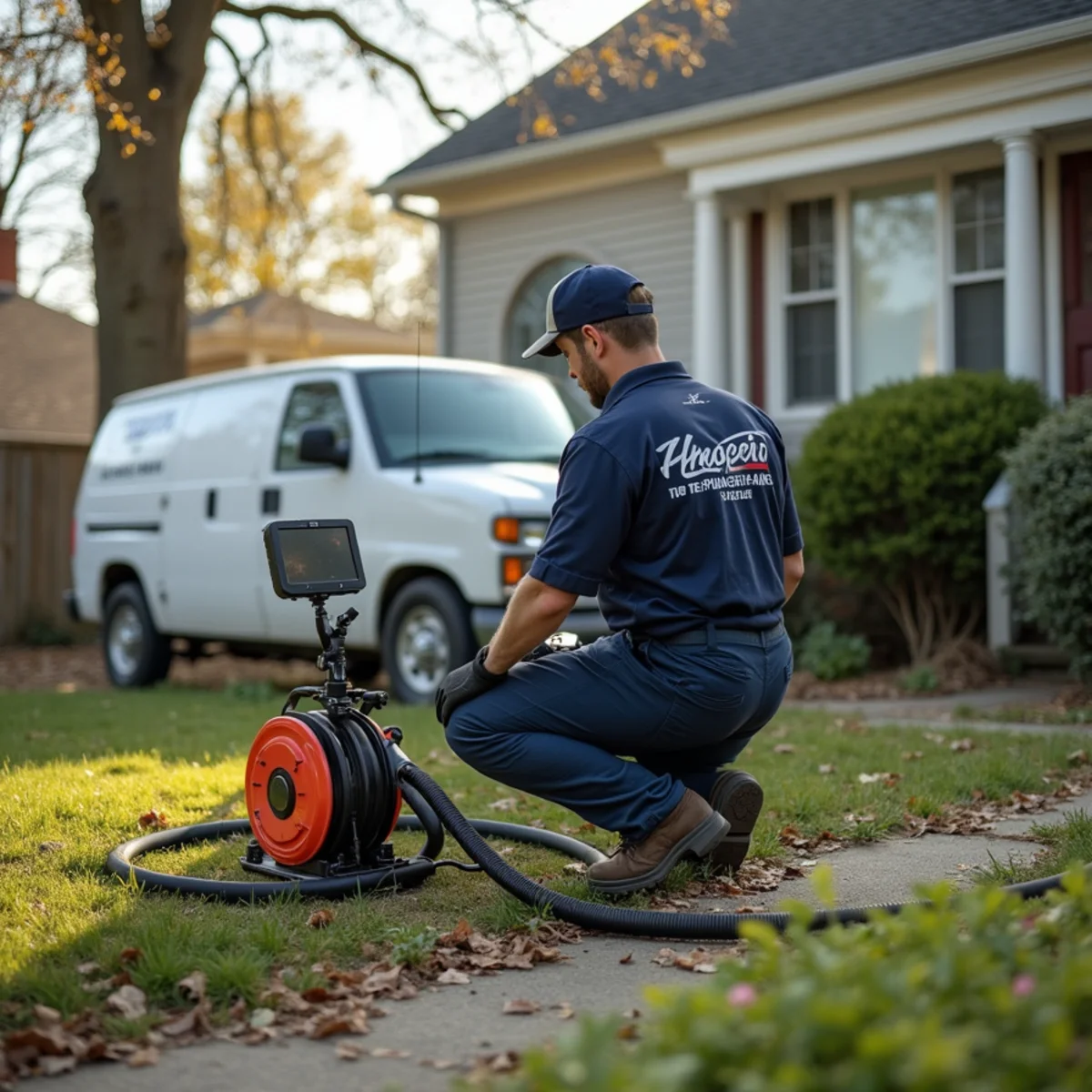
Sewer Camera Inspection Services
Sewer scope inspection in Sterling Heights, MI
A sewer scope inspection in Sterling Heights is a camera inspection performed and documented specifically to support a real-estate decision — a purchase, a sale, or a second opinion on a repair estimate — rather than a routine maintenance check. The distinction is in the paperwork: a scope you can actually rely on states the access point used, the direction the camera traveled, the inspected distance, where the run ended, every visible finding along the way, and the inspection's limitations, so a buyer, seller, agent, or lender has something concrete to act on.
- Recorded HD video
- Same-day report
- Licensed & insured
Standard home inspectors don't run a camera down the sewer lateral — it's outside their scope of practice. That leaves the most expensive hidden system in an older Metro Detroit home completely unverified at exactly the moment buyers and sellers most need certainty about it.
That's the gap a sewer scope closes. Whether you're a buyer protecting an offer, a seller clearing a line before it becomes a bargaining chip, or an agent keeping a deal from unraveling at the inspection table, the value is the same: recorded video and a written report that still speaks for itself after we've left the property.
Who orders a sewer scope inspection
A scope answers one question for people about to take on real risk: what shape is this line in, and what am I actually buying, selling, or approving?
- Buyers under contract on a pre-1980 Sterling Heights or Macomb County home with an unknown lateral
- Buyers whose home inspector flagged slow drains but couldn't look underground
- Sellers who want to clear the line before listing so it can't become a last-minute renegotiation
- Listing agents protecting a deal on an older, long-vacant, or inherited property
- Buyer's agents wanting independent footage before advising a client to waive further inspections
- Homeowners settling an estate or refinancing who need a documented condition record
- Anyone comparing a scope's findings against a contractor's repair recommendation
What happens during a sewer scope appointment
- 1
Access confirmation
We locate an accessible cleanout or approved entry point and note any access limitations up front.
- 2
Full recorded run
The camera travels the lateral while we record and narrate visible conditions in real time.
- 3
Direction, distance & endpoint
We track which way the camera traveled, the distance covered, and where the run ended — municipal tap, property line, obstruction, or the camera's limit.
- 4
Findings logged in place
Every root intrusion, crack, offset joint, belly, or material change is logged with its approximate location.
- 5
Written report + video delivered
You receive the video, still images, and a written summary formatted for a purchase, sale, or repair decision, with limitations clearly stated.
- 6
A quick walkthrough of what it means
We explain the findings in plain language so you know how they affect your contingency, listing timeline, or repair decision.
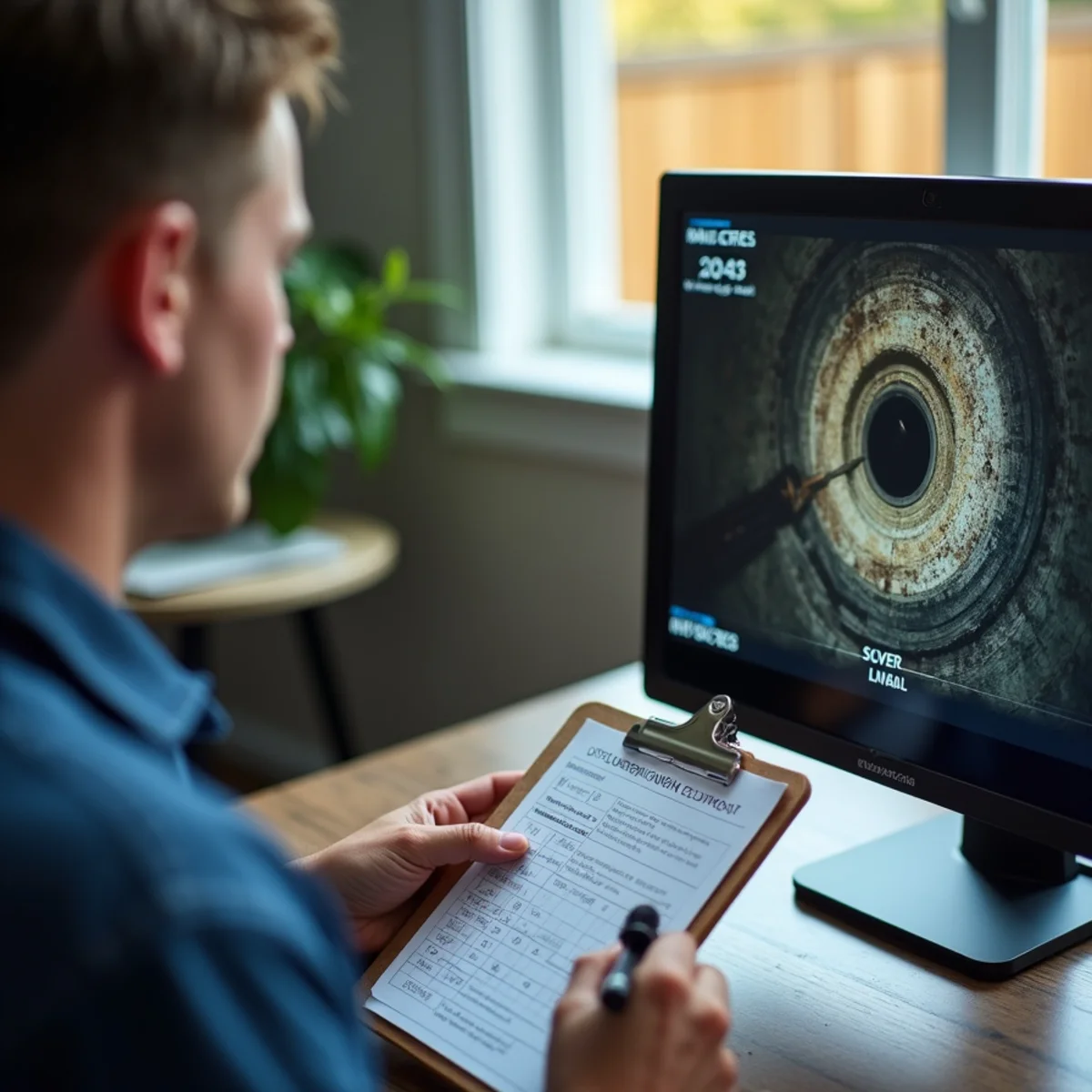
What affects sewer scope pricing
Scopes fall in the same range as any camera inspection — commonly $200–$500 locally for a straightforward line, with longer or harder-to-reach lines running roughly $225–$500, $500–$975, or $975–$1,900 depending on distance. Detroit-area research puts the broader range at $254–$1,722, averaging about $955 on complex jobs.
- Cleanout availability vs. needing alternate access (e.g., pulling a toilet)
- Line length and whether the camera reaches the municipal connection
- Whether standing water or a blockage requires clearing before the camera can travel
- Turnaround — most purchase and listing scopes need same-day or next-day footage
- Written report formatting requested by a buyer's agent, lender, title company, or insurer
- Whether locating equipment is needed to mark a defect's surface position for a future repair quote
What's included in your sewer scope report
Every sewer scope we run in Sterling Heights ends with the same deliverable: recorded evidence, not a verbal impression you have to take on faith. Whether you're forwarding it to a buyer's agent, attaching it to a listing disclosure, or filing it with an insurer, here's what you're getting:
Your sewer scope report includes
- Full HD video of the run, recorded start to finish
- Still images pulled from each visible defect or point of interest
- The access point used to enter the line (cleanout, drain, or alternate entry)
- Direction of travel — toward the street, toward the house, or both
- Approximate inspected distance, in feet
- The run's endpoint — municipal tap, property line, an obstruction, or the camera's practical limit
- Pipe material noted where visible (clay, cast iron, Orangeburg, PVC)
- Every visible finding with its approximate location along the run
- A plain-English written summary stating limitations — what the camera could and couldn't confirm
Sewer scope vs. general camera inspection: what's actually different
The two use identical equipment — a push-cable camera, a monitor, and usually a sonde locator. The difference is documentation and intent. A general sewer camera inspection answers 'what's going on in this line right now,' often triggered by a backup or slow drain. A scope is the same camera work reframed for a transaction: the report is written so a buyer, seller, agent, or lender who wasn't standing next to the monitor can still understand what was checked and what it means.
That's why a scope report always states the access point, direction, distance, and endpoint explicitly, even when nothing's wrong — a clean line with a documented endpoint is worth as much in a negotiation as a line with a defect. A casual 'looks fine' with no fixed record doesn't hold up the same way at a closing table.
Why limitations matter as much as findings
A report that hides its limitations is worse than no report. If the camera stopped short of the municipal tap because of standing water, that belongs on the page — it changes how much weight a buyer, lender, or insurer can put on 'no defects found.'
Pipe materials we still find under Sterling Heights homes
Homes built before the 1980s in Sterling Heights and neighboring communities like Rochester Hills commonly run on clay, cast iron, or Orangeburg laterals. Clay joints separate and invite roots, cast iron corrodes and scales, and Orangeburg deforms and can collapse decades later. A scope identifies which material sits under the property, which tells you a lot about remaining service life before any defect shows up on camera.
What the camera can — and can't — prove
A scope shows interior pipe condition, joints, and any obstruction across the inspected distance. It can't predict a future failure, see through standing water with certainty, or inspect a branch line outside the camera's direct path. Stating that in writing is what makes the rest of the report worth trusting.
For buyers, sellers, and agents: putting the report to work
If your pre-purchase sewer inspection turns up a defect, the video and location notes are exactly what your agent needs to request a credit, ask for a repair, or reconsider the deal. Ordering a pre-sale sewer scope before you list does the same work in reverse — you learn the line's condition on your own timeline, not the buyer's deadline, so you can repair, price around it, or disclose with confidence.
Before you book a purchase or pre-listing scope
- Confirm there's an accessible cleanout, or ask what the alternate entry point will be
- Ask what the report will state: access point, direction, distance, endpoint, findings, and limitations
- Set your turnaround needs against your inspection contingency or listing date
- Read our sewer scope inspection guide for home buyers for what to expect from your own scope
How we choose an access point when there's no cleanout
Not every Sterling Heights or Macomb County home has a visible exterior cleanout — plenty of pre-1980s houses were built without one, or it's been paved over, buried under a deck, or capped and forgotten. When that's the case, we don't just walk away; we work through the next-best entry point in order of least disruption: an interior cleanout in a basement or crawlspace, the main drain through a laundry standpipe, or, as a last resort, pulling a toilet closest to the stack. Whichever entry we use gets documented in the report so a future contractor knows exactly how the line was accessed.
Equipment behind the picture: sonde locating and footage counters
A scope report's stated distance isn't a guess — it comes from a footage counter built into the reel that tracks exactly how far the camera has traveled. When a finding needs a surface location for a future dig or repair quote, we can also run a sonde transmitter behind the camera head and trace its signal from above ground with a locator wand, marking the defect's approximate depth and position on the lawn or driveway. That's the same locating work covered in more depth under our sewer line locating service, and it's often bundled into a scope when a buyer or seller already expects a repair to follow.
Choosing between a sewer scope and a related inspection
"Sewer scope" is the right term most of the time, but not always the right service. A quick way to tell which one fits your situation:
Which inspection actually fits your situation
- Under contract and need a report your agent or lender can act on — a pre-purchase sewer inspection is built for exactly that timeline
- Listing soon and want to clear the line before a buyer's inspector finds it first — see real estate sewer inspection
- Already know there's a defect and just need recorded proof to compare repair bids — a sewer line video inspection puts the emphasis on the file itself
- Need the defect's physical position marked on the surface before anyone digs — that's sewer line locating
- No transaction or known problem, just want current condition on file — a general sewer camera inspection covers that
A Sterling Heights scenario: the 1968 ranch under contract
A buyer was under contract on a 1968 ranch near Dodge Park, and the home inspector had flagged "drains slower than expected" but couldn't go further — sewer laterals aren't part of a standard home inspection. With eight days left on the inspection contingency, we scoped the line the next morning through an accessible cleanout near the foundation. The camera confirmed original clay pipe and found a root mass at a separated joint roughly 38 feet from the house, with the run continuing clean to the municipal tap beyond that point.
Because the report stated the exact distance, the pipe material, and a still image of the joint, the buyer's agent used it to request a specific repair credit rather than a vague "sewer concerns" allowance — and the seller agreed within a day, because the video left no room to argue about whether the issue was real. That's the difference a documented scope makes over a verbal "it's probably fine down there."
Common mistakes buyers, sellers, and agents make with a sewer scope
Mistakes worth avoiding
- Waiting until the final days of the contingency to schedule, when access or scheduling problems leave no room to react to findings
- Accepting a verbal "looks clean" instead of a written report stating access point, direction, distance, and endpoint
- Assuming a home built after 1980 on PVC can't have a problem — installation damage, bellies, and crushed sections still happen on any material
- Not asking whether the camera reached the municipal tap or stopped short — a partial inspection is not the same as a clean one
- Treating the scope as a formality instead of leverage — a documented defect is negotiating power only if it's on paper before the deal closes
Why Macomb County's clay soil and older laterals make scoping non-negotiable
Sterling Heights and the rest of Macomb County sit on heavy clay soil that swells when wet and shrinks when dry, and that movement works on buried pipe joints year after year. Add Michigan's freeze-thaw cycle, and a clay or Orangeburg lateral installed in the 1960s or '70s has had five decades of ground movement to separate a joint or deform a section — often with zero visible symptoms above ground until closing day. Homes throughout Macomb County and communities like Clinton Township built in that era carry this risk at roughly the same rate, regardless of how well-kept the house looks.
The 2016 and 2021 Metro Detroit flooding events also pushed groundwater levels high enough to stress already-weak joints and back-pressure marginal lines that had been getting by for years — our post on clay sewer line failure in Metro Detroit covers why those events matter even for a line that scoped clean five years ago. If you're weighing whether a scope is worth the cost on an older purchase, our sewer camera inspection cost guide for Metro Detroit breaks down what drives the price on both sides of a transaction.
Why Sewer Inspects
Why choose us for sewer scope inspection
12+ years scoping Metro Detroit laterals
We've run scopes under homes from every era across Sterling Heights, Macomb County, and Metro Detroit, so we know what a genuine defect looks like versus a camera artifact.
Licensed & insured, no dig-selling
We're a licensed, insured inspection provider — not an excavation company scoping your line to sell you a job. The report says what the camera showed, good or bad.
Video, stills, and a written report you keep
Every scope leaves you holding recorded HD footage, still images, and a written summary stating access point, direction, distance, endpoint, and limitations.
Same-day and next-day scopes for real deadlines
Purchase contingencies and listing dates don't wait. We prioritize turnaround on real-estate scopes, with 24/7 availability for anything urgent.
Answers
Sewer Scope Inspection — FAQs
Where we offer sewer scope inspection
We run sewer scope inspections for buyers, sellers, and agents throughout Sterling Heights and across Macomb County, including Troy, Rochester, Rochester Hills, Royal Oak, and Birmingham — communities with enough pre-1980 housing stock that an undocumented lateral shows up in nearly every other transaction. Same-day and next-day scheduling is typically available to fit an inspection contingency or a listing deadline.
Wherever the property sits in Metro Detroit, the report format doesn't change: access point, direction, inspected distance, endpoint, findings, and limitations — clear enough for a buyer, seller, agent, or lender to act on without us in the room.
A few of the communities we serve — see all on our service areas page.
Related services
Pre-Purchase Sewer Inspection
Scope the lateral before you close. A few hundred dollars of footage can save you from inheriting a five-figure sewer repair.
Learn moreSewer Camera Inspection
A recorded HD look inside your sewer line — roots, cracks, bellies, and blockages confirmed on video before you spend a dollar on repairs.
Learn moreReal Estate & Pre-Sale Sewer Inspection
Sellers and agents: scope the line before you list, so a buyer's inspection can't blindside your deal at the closing table.
Learn moreHelpful reading
Ready to book sewer scope inspection?
Same-day sewer camera inspection across Sterling Heights, Macomb County & Metro Detroit. Free quote — call (614) 830-0578 or request a callback.
13+ years experience • Licensed & insured • 24/7 emergency response