

Sewer Camera Inspection Services
Sewer line video inspection in Sterling Heights, MI
A sewer line video inspection in Sterling Heights, MI is a recorded HD camera run through your private sewer lateral — the point of the appointment is the file you keep afterward, not just a verbal read on the line. Instead of hearing "it looks bad down there," you get the actual video: direction, distance traveled, endpoint, and every visible defect captured on camera.
- Recorded HD video
- Same-day report
- Licensed & insured
That recording is leverage. Put the same footage in front of two or three repair contractors and compare their bids on identical evidence instead of taking each one's word for it. Attach it to an insurance claim, a real estate disclosure, or a dispute file. Hand it to a second opinion. Once a repair is done, record again and confirm the fix actually worked instead of hoping it did.
We record every run in HD, capture still images of each significant finding, and deliver the file in a format you can forward to anyone — a contractor, an insurer, a buyer's agent, or your own records — along with a written summary stating what we saw, how far the camera traveled, and where it stopped.
When a recorded video inspection makes the biggest difference
A sewer line video inspection is worth booking any time you need something more durable than a verbal diagnosis:
- You're collecting multiple repair or replacement bids and want every contractor working from the same evidence
- You need documentation for an insurance claim, a home sale disclosure, or a dispute with a contractor, tenant, or neighbor
- A repair, lining, or replacement was just completed and you want to confirm on camera that it actually fixed the problem
- You want an independent recording before agreeing to a contractor's diagnosis
- You own an older Sterling Heights-area home and want a baseline recording on file before any problem shows up
- You're closing on a home purchase or sale and want recorded proof of the private lateral's condition, not a summary
How we capture and deliver the video
Every video inspection follows the same sequence, whether it's a first look or a post-repair confirmation:
- 1
Confirm access & the goal
We locate the cleanout or another approved access point and confirm what the recording needs to show — a first look, a second opinion, or confirmation of finished repair work.
- 2
Insert the camera
A flexible push cable carries a waterproof HD camera head into the line, and we start recording before the camera passes the access point so nothing is cut from the file.
- 3
Record the full run continuously
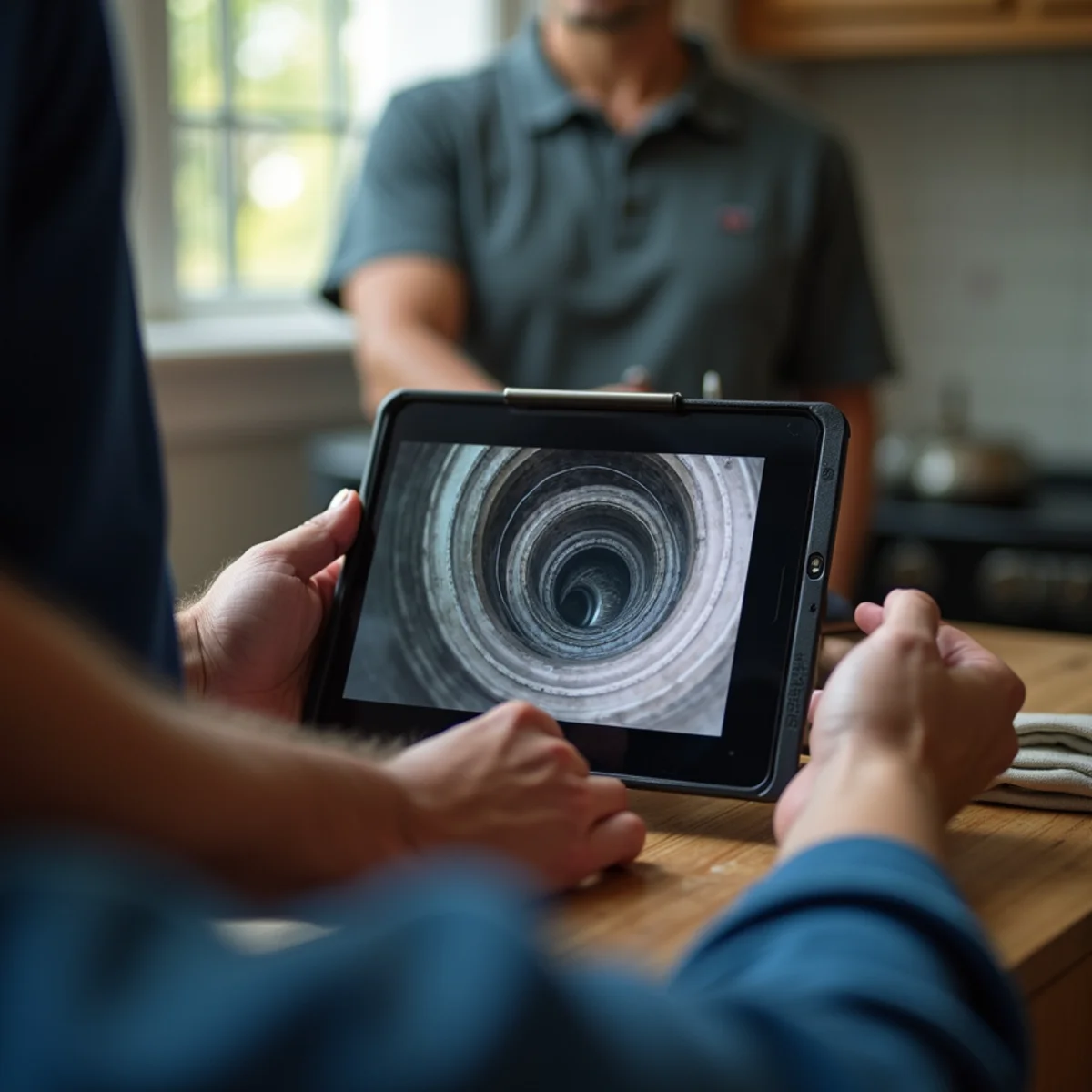
We advance the camera on a live monitor, recording distance markers, pipe material, joints, and every visible condition without stopping to skip sections.
- 4
Capture still images of key findings
At each significant defect — a crack, an offset, root intrusion, a belly, a blockage — we pause to grab a still image and note its approximate location.
- 5
Deliver the file & written notes
You receive the video file in an agreed digital format along with a written summary covering inspected distance, endpoint, pipe material, and findings.
What drives sewer line video inspection cost
Video inspection pricing tracks the general camera-inspection range in Sterling Heights. A straightforward local inspection commonly runs about $200–$500, and Detroit-area research puts the wider range at $254–$1,722 with roughly a $955 average on complex jobs. We confirm your price in writing before starting — the main variables are:
- Line length — commonly $225–$500 under 50 feet, $500–$975 for 50–100 feet, and $975–$1,900 beyond 100 feet
- Whether the line needs to be cleared or cleaned before a usable recording is possible
- Whether you're adding locating and depth information to the video, not just the visual record
- Access — a missing, buried, or damaged cleanout can add time before recording even starts
- Number of runs needed — a single first-look recording versus a first look plus a post-repair confirmation
- Delivery format and any extra formatting you need for the written report
What's included with your sewer line video inspection
Every appointment ends with a documented file, not just a conversation. Here's exactly what you walk away with:
- Continuous HD video recording of the full run
- Still images captured at each significant finding
- Approximate inspected distance and the camera's stopping point (endpoint)
- Pipe-material notes (clay, cast iron, PVC, Orangeburg, and transitions)
- Approximate defect location when conditions allow locating
- Video file delivered in an agreed digital format you can forward to anyone
- Plain-English written summary separate from any repair recommendation
Why the recording — not our opinion — is the real deliverable
Most sewer problems get diagnosed by whoever shows up with a truck and an opinion. A sewer camera inspection answers the same underlying question, but a dedicated video inspection puts the emphasis on the file itself, because a recording doesn't change its story depending on who's paying for the repair.
Comparing repair bids on one piece of evidence
Get three quotes for a suspected collapsed or broken section and you'll often get three different descriptions of what's wrong, because each contractor watched a different few minutes of video, or none at all. Send every bidder the same recording, and the conversation changes from "trust me" to "here's exactly what you're pricing." If a bid calls for full replacement, our collapsed & broken pipe inspection service can confirm on camera whether the damage is really that extensive first.
Insurance, sale, and dispute documentation that holds up
Adjusters, buyers' agents, and property managers all want a dated, specific record, not a summary of memory. A timestamped HD recording with still images and a written distance-and-endpoint report gives you something concrete for a claim file or disclosure — see why video inspection beats guessing.
Verifying a completed repair, and building a baseline
Confirming a repair actually worked
A repair invoice tells you money changed hands. It doesn't tell you the crack is sealed or the root intrusion is gone. Running the camera again on the same line after the work is finished, using the same access point, gives you a direct before-and-after comparison instead of a contractor's assurance that the job is done.
Baseline recordings for older lines
If your home still runs on clay, cast iron, or Orangeburg pipe, a baseline recording now is worth more than it looks. It gives you and any future contractor a documented starting point so a problem five years from now can be compared against real footage instead of guesswork — especially common in older neighborhoods throughout Shelby Township and Sterling Heights, where clay and Orangeburg laterals are still common under homes built before the 1970s.
What the video can — and can't — prove
Recorded footage is strong evidence, but it's only honest if it says what it didn't see. The camera can only show what it physically reaches: a complete blockage, a sharp offset, a collapsed section, or standing water can all stop the run short. That's why every report states the inspected distance and the exact endpoint where the recording stopped, not just what we saw. If the camera stops well short of the property line, our sewer camera inspection team can walk you through whether a cleared line or a different access point completes the picture. If what stopped the camera looks like a genuine structural failure rather than routine debris, a closer look with collapsed & broken pipe inspection makes sense before anyone recommends excavation.
Active backup right now?
Stop water use and document conditions before cleanup starts. Call (614) 830-0578 — we can record current conditions before repair work begins, which matters if you'll need that footage for an insurance file later.
How we shoot a video that actually holds up later
A usable record isn't just "point the camera and go." We start recording before the head passes the access point so the file shows the entry itself, keep a steady, deliberate travel speed so nothing blurs past on playback, and narrate distance markers, pipe material, and joint locations out loud as we go so the audio and video match the written summary line for line. When a finding needs a closer look, we pause and hold the frame rather than skimming past it — the difference between footage a contractor can actually use and footage that just proves we showed up.
Lighting, angle, and why some footage is unusable
Poor footage usually comes down to three things: a dirty lens dragged through debris without clearing it first, a camera pushed too fast to focus on anything, or standing water hiding the pipe wall behind glare. We clear the lens and, where needed, the line itself before recording, and we call out in the report anywhere water or debris limited visibility — because footage that hides its own blind spots isn't documentation, it's decoration.
Video inspection vs. a scope vs. locating — which recording do you actually need
"I want it on video" can mean a few different things depending on why you're asking. Here's how to match the goal to the right service:
Matching your goal to the right recording
- Comparing repair bids or documenting for insurance or a dispute — this service, built around the file itself as the deliverable
- Buying or selling and need a report formatted for an agent, lender, or title company — see sewer scope inspection
- Already know roughly where the problem is and need it marked on the surface before digging — see sewer line locating
- Suspect the line has fully collapsed rather than just cracked — collapsed & broken pipe inspection confirms the extent before anyone quotes a full replacement
- No specific goal yet, just want to know the line's current condition — a general sewer camera inspection is the starting point
A Clinton Township scenario: three bids, one recording
A homeowner in Clinton Township had a slow, recurring backup and three plumbers had each given a different verbal diagnosis — a root problem, a belly, and "probably needs full replacement." We ran a complete video inspection through the exterior cleanout and recorded a cracked, offset joint about 42 feet out with moderate root intrusion, but a sound line on either side of it. We sent the homeowner the file with distance and endpoint noted.
Armed with the same recording, all three plumbers priced a localized spot repair instead of a full replacement — because none of them could argue with what the footage showed. The homeowner picked a bid based on price and availability instead of which contractor's guess sounded scariest, and saved several thousand dollars against the "full replacement" quote that had assumed the worst without ever seeing the pipe.
Common mistakes homeowners make with sewer video evidence
What to avoid
- Getting a verbal diagnosis from one contractor and skipping the recording entirely, then having no way to compare a second opinion
- Losing track of the video file instead of saving it somewhere permanent — it's only useful later if you can still find it
- Assuming any phone video a plumber shows you on-site is the same as a delivered, dated file with a written summary
- Not recording a post-repair confirmation, then having no proof if the same problem resurfaces months later
- Filing an insurance claim on a verbal description of damage instead of attaching the actual timestamped footage
Groundwater, clay soil, and why Macomb County homeowners keep footage on file
Sterling Heights and Macomb County sit on clay-heavy soil with a naturally high water table, and the 2021 Metro Detroit floods pushed groundwater high enough to stress aging clay and Orangeburg laterals across the region, including areas near the Clinton River and Lake St. Clair where drainage was already marginal. A line that recorded clean two years ago can shift after an event like that, which is exactly why a dated recording is worth more than memory — it gives you and any future contractor a fixed comparison point instead of a guess about when a defect appeared.
We record these baseline and follow-up inspections throughout Sterling Heights and Warren, where older clay and cast-iron laterals are still common enough that a homeowner rebuilding a claim file or comparing bids benefits from the same documentation standard every time.
Why Sewer Inspects
Why choose us for sewer line video inspection
You keep the actual footage, not our word for it
Every inspection hands you the recorded HD file, still images, and a written summary — evidence you own and can share with anyone.
One independent recording works for every audience
Because we inspect and don't sell repairs, the same footage holds up whether you're comparing bids, filing a claim, or disclosing condition on a sale.
12+ years reading Metro Detroit sewer lines
We've recorded clay, cast-iron, PVC, and Orangeburg laterals across Sterling Heights and Macomb County long enough to know a genuine defect from a shadow or camera-angle artifact.
Same-day scheduling and 24/7 emergency response
Need a baseline recording on your schedule or an emergency run during an active backup — we handle both, and we're licensed and insured for every job.
Answers
Sewer Line Video Inspection — FAQs
Where we offer sewer line video inspection
We record sewer line video inspections throughout Sterling Heights and the surrounding Macomb County communities we know well — Shelby Township, Macomb Township, Clinton Township, Utica, and Warren among them. Many of these neighborhoods share the same aging clay and Orangeburg laterals, exactly the kind of line worth having on video before and after any work.
Wherever you're located in the area, we bring the same camera, the same recording standard, and the same delivery format, so footage from Shelby Township is exactly as usable as footage from Sterling Heights itself.
A few of the communities we serve — see all on our service areas page.
Related services
Sewer Camera Inspection
A recorded HD look inside your sewer line — roots, cracks, bellies, and blockages confirmed on video before you spend a dollar on repairs.
Learn moreSewer Scope Inspection
The scope buyers, sellers, and agents ask for — full HD video of the lateral with a written report stating access point, direction, distance, endpoint, and findings.
Learn moreCollapsed & Broken Pipe Inspection
Before you approve a five-figure excavation, confirm the collapse or break on video and locate it — so the dig targets the right spot.
Learn moreHelpful reading
Ready to book sewer line video inspection?
Same-day sewer camera inspection across Sterling Heights, Macomb County & Metro Detroit. Free quote — call (614) 830-0578 or request a callback.
13+ years experience • Licensed & insured • 24/7 emergency response