
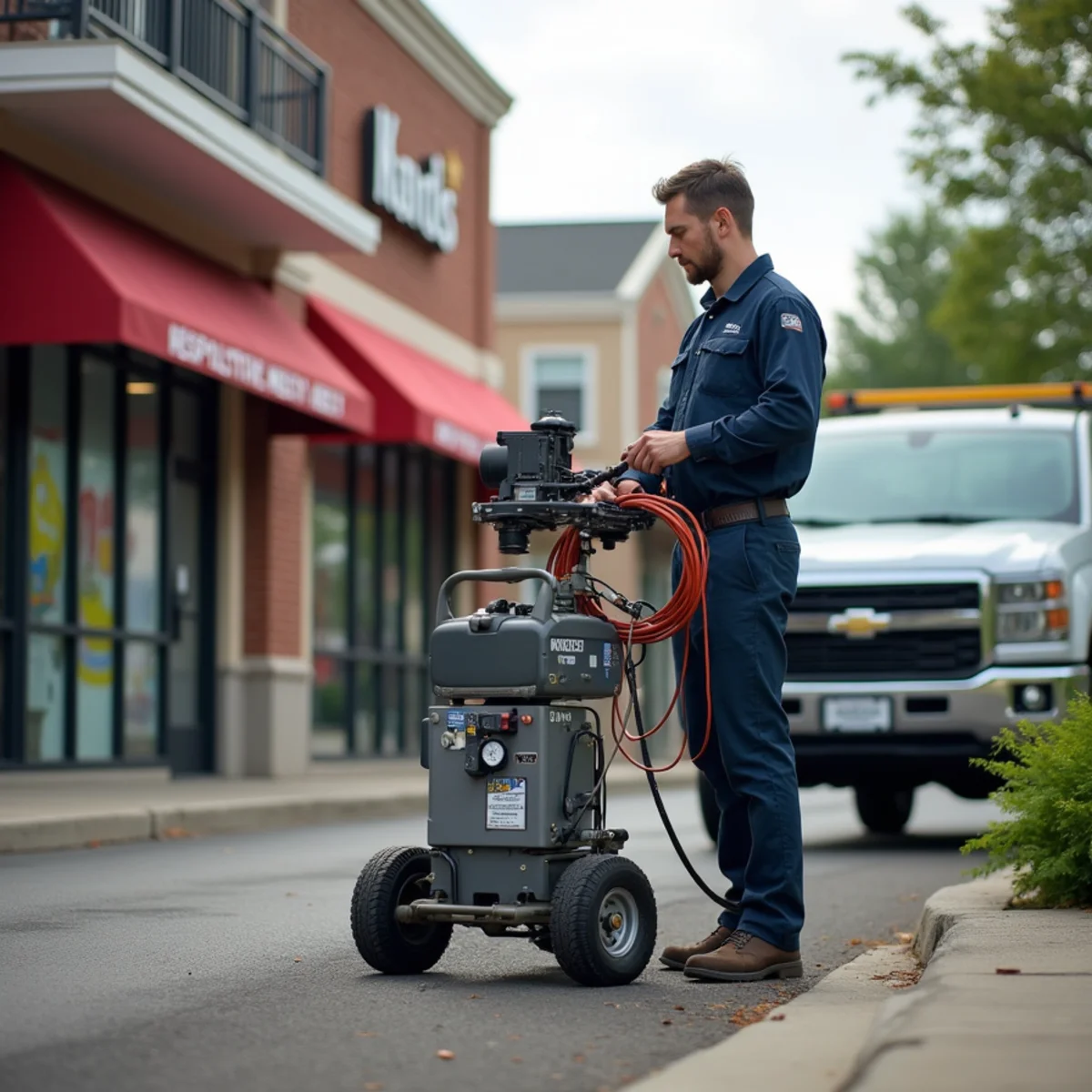
Sewer Camera Inspection Services
Commercial sewer camera inspection in Sterling Heights, MI
A commercial sewer inspection in Sterling Heights is a recorded camera scope of a commercial building's sewer lateral, or laterals, that gives landlords, property managers, and building owners hard evidence of the line's condition — not a guess based on a slow drain or a complaint from unit 4. For a commercial property, a sewer failure isn't just a repair bill; it's downtime, a health-code problem if it's a restaurant, angry tenants, and potential liability if you can't show when the line was last documented.
- Recorded HD video
- Same-day report
- Licensed & insured
Restaurants build grease inside their drain lines faster than almost any other tenant type. Multi-unit apartment buildings and strip malls put heavy, constant load on shared laterals sized decades ago for less use. And older commercial buildings across Macomb and Oakland County carry the same clay, cast-iron, and mixed-material risk as the houses around them — just at a bigger diameter, with more stub-ins to track.
A commercial sewer camera inspection gives you documented condition for planned maintenance, purchase or lease due diligence, tenant turnover, and dispute resolution — footage and findings you can file, forward to an insurer or attorney, or hand to the next vendor bidding the repair.
When commercial properties need a scope
We get called in for a mix of planned due diligence and active problems. Common triggers include:
- Recurring backups in a restaurant, retail space, or multi-unit building
- Due diligence before buying or leasing a commercial property
- Tenant turnover where you want the line documented before the next lease starts
- Preventive maintenance on an aging commercial lateral or building sewer main
- A dispute over responsibility for a drain or sewer problem between tenant and landlord
- Grease buildup causing repeat slow drains in a food-service line
- Heavy fixture counts in a multi-unit building overloading an older, undersized lateral
- Needing the inspection scheduled around business hours so operations aren't interrupted
How a commercial inspection works
Commercial work usually involves more lines, more stakeholders, and tighter scheduling constraints than a single-family scope. Here's how we handle it:
- 1
Scope the work
We talk through your building — lines, units or tenants, and what you need answered — then identify the relevant access points.
- 2
Schedule around operations
We plan for a time that works for your business — after hours, a slow period, or phased across units — so the inspection isn't its own disruption.
- 3
Inspect & record
We camera the lateral(s), documenting condition, defects, grease or debris buildup, and material transitions.
- 4
Locate as needed
Where a defect needs a precise surface reference, we locate it with a sonde so any dig is targeted, not exploratory.
- 5
Deliver documentation
You get the recorded footage, still images, and a written summary suitable for maintenance, due diligence, or a dispute.
- 6
Review priorities
On multi-line properties, we help rank findings by urgency — what needs attention now versus the maintenance schedule.
Commercial inspection pricing factors
There's no single commercial price — a one-line strip-mall scope and a multi-building apartment complex are different jobs. For context, a straightforward local camera inspection commonly runs about $200–$500, with line-length ranges of roughly $225–$500, $500–$975, and $975–$1,900 for longer runs, and Detroit-area research reporting a broader $254–$1,722 range with about a $955 average on more complex jobs. Commercial properties often land on the longer, more complex end of that spectrum because of line length, access, and cleaning needs. We quote per property based on:
- Number and length of lines to be inspected
- Building complexity and access points — multiple stacks, roof vents, crawlspaces, or buried cleanouts
- Whether cleaning is required before inspection, which is common on grease-heavy food-service lines
- Documentation and reporting requirements for a due-diligence file, insurer, or dispute
- Scheduling around business operations, including after-hours or weekend appointments
- How many units or tenant spaces share a single lateral
What's included in a commercial sewer inspection
Whatever triggered the call — maintenance, a sale, a lease, or a dispute — every commercial inspection produces the same documentation package. That consistency is what makes the report useful months later, whether it's sitting in a maintenance file or getting attached to a demand letter.
Every commercial inspection includes
- Recorded HD video of each lateral inspected
- Still images marking key findings and defect locations
- Approximate inspected distance and endpoint for each line
- Pipe-material notes across the building's plumbing history (clay, cast iron, PVC, transite, Orangeburg)
- Defect location via sonde locator when conditions allow, referenced to a fixed point on the property
- A plain-English written summary you can file for maintenance, due diligence, or a dispute record
Pipe materials and defects in commercial buildings
Older commercial buildings across Sterling Heights, Warren, and the rest of Metro Detroit were built across several decades, so it's common to find two or three pipe materials in one building's history — clay or transite laterals from the original construction, cast-iron risers and stacks, and PVC from a past repair. Each transition point is a place roots and offsets like to form. We're looking for the same defects we'd flag on a residential job — root intrusion, cracked or offset joints, bellies holding water, partial or full blockage — but across a longer run with more junctions. A sewer line video inspection of the full run, not just the section nearest a problem fixture, is what catches a defect two units away from where the backup actually showed up.
Restaurant and food-service grease lines
A grease trap slows buildup, it doesn't stop it. Fat, oil, and grease still coat the inside of a food-service line over time, narrowing it until a normal service load backs up — usually mid-shift. The camera shows what a cleaning log can't: how much buildup remains on the pipe walls right now, and whether there's a structural defect underneath it that cleaning alone won't fix. That distinction matters before you approve another round of jetting or sign off on a new tenant's build-out, and it's a common ask during turnover, when a landlord wants the kitchen line documented before the next restaurant tenant takes possession.
Multi-unit buildings and heavy drain loads
A shared lateral under an apartment building, strip mall, or office complex carries far more daily flow than a single-family line, and it was often sized for a different era of tenant use. When one unit's fixtures back up, the cause is frequently downstream — a shared main taking on more volume than it was built for, or a defect that only shows symptoms in the unit closest to the blockage. Documenting the shared line on camera is how you fairly allocate responsibility between units when a backup affects more than one tenant, instead of guessing which lease is on the hook.
Due diligence before you buy or lease a commercial property
The sewer lateral is one of the most expensive systems in a commercial building, and it's routinely left out of a standard property condition assessment. If you're closing on a building or signing a multi-year lease, that's a costly blind spot — the same one we cover on the residential side with a real estate sewer inspection before a home sale. On the commercial side, we scope the line before you sign, so any defect gets negotiated into the deal instead of discovered after you're responsible for it — the exact scenario covered in our guide on commercial pre-sale and lease sewer scoping. It's a step we also walk landlords and property managers through as a standard part of due diligence, and we handle this kind of work for office parks and retail centers throughout the Troy service area and beyond.
What the camera can — and can't — prove
A sewer camera inspection shows the interior of the pipe at the moment we run it: material, cracks, offsets, roots, bellies, and blockage, all on recorded video you keep. It can't predict exactly when a marginal section will fail, assess soil conditions outside the pipe, or inspect a section the camera physically can't reach, such as a fully collapsed run. We tell you plainly when a finding is definitive versus a risk factor worth monitoring — an honest limitation beats false certainty.
Independent findings, no dig-selling
We inspect and document — we don't sell excavation or lining work. That keeps our findings usable as neutral evidence when you're comparing repair bids, supporting an insurance claim, or settling a tenant dispute.
Access, equipment, and what limits a commercial scope
Commercial laterals are usually bigger and longer than a residential line — 6- to 10-inch mains instead of 4-inch, sometimes running 150 feet or more from the building to the street tap. A standard push-camera reel handles most single-tenant runs in one pass, but a large multi-building property, a strip mall with several stub-ins, or a lateral with multiple bends may need the reel extended, a secondary access point opened, or the run broken into segments. Access itself varies more than on a house: we've entered commercial lines through exterior cleanouts, roof vents, floor drains in a mechanical room, and buried cleanouts under a parking lot that need to be located first. Heavy grease or sediment buildup — common in food-service lines — can stop the camera short of a full run, in which case jetting or cleaning first is the only way to get a complete picture rather than a partial one.
When a defect turns up and you need to know exactly where it sits before anyone breaks pavement or opens a wall, we pair the camera with a sewer line locating pass using a sonde transmitter. That's the difference between telling a contractor "somewhere under the loading dock" and giving them a marked spot with a depth reading — it's what keeps a commercial excavation targeted instead of exploratory, and it matters even more on a property with underground utilities, irrigation lines, or a parking structure to work around.
Deciding how much of the building to scope
Not every call needs a full-building assessment, and not every spot check tells you what you actually need to know. A few questions usually settle it:
Spot-check a single line vs. scope the whole system
- One unit or tenant space has a recurring problem and the rest of the building is unaffected — a spot check of that line is often enough
- Multiple units share a lateral, or more than one tenant has reported backups — scope the shared run, not just the nearest branch
- You're closing on a purchase or signing a lease — document every line the deal will make you responsible for, not just the one with symptoms today
- The building has more than one sewer connection or has been added onto over multiple decades — assume the lines were tied in at different times with different materials
- You're planning a capital budget for the next 3–5 years — a full-system baseline scope gives you a document to plan around instead of reacting line by line
A recurring backup at a Sterling Heights strip mall
A property manager called us about a strip mall on Van Dyke where a nail salon and a small restaurant shared a single lateral, and the salon kept flooding every few weeks even though the restaurant had never had an issue. Two plumbers had already snaked the line from the salon's cleanout with only short-term relief. We ran a full camera scope of the shared lateral from the restaurant's grease-trap outlet all the way to the street tap, and found the real problem two units away from the complaint: a cracked clay joint near the property line was letting roots in, and grease from the restaurant's line was catching on those roots and building a partial dam that backed pressure up toward the salon first, since it sat at a slightly lower elevation. Snaking the salon's own line had never touched the actual defect. With the footage in hand, the property manager split the repair cost between both tenants' leases based on documented cause, instead of assuming it was the salon's problem because that's where the water showed up.
Common mistakes commercial property owners make
- Treating a single jetting or snaking as a permanent fix on a grease-prone food-service line, instead of documenting whether a structural defect sits underneath the buildup
- Assuming a plumber's snake report is the same as a recorded camera inspection — a snake tells you it went through; it doesn't show you what's actually wrong with the pipe
- Skipping a sewer scope before a tenant build-out, then discovering the existing line can't handle the new tenant's fixture count or grease load
- Waiting until more than one unit is affected before scoping a shared lateral, which makes it harder to pin down where a defect actually sits
- Assuming a triple-net lease shifts all sewer responsibility to the tenant without documentation — a dispute over a shared or ambiguous line almost always comes down to who has evidence
- Closing on a commercial property or signing a long lease without ever having the lateral scoped, on the assumption that a general property condition report covers it
Macomb County's aging commercial corridors
Much of the commercial development along corridors like Van Dyke, Mound Road, and Hall Road in Sterling Heights and neighboring Warren went up between the 1950s and 1980s, often on the same clay-tile lateral stock used in the residential subdivisions around them — see our breakdown of clay sewer line failure across Metro Detroit for why that material fails the way it does after 40–70 years in the ground. Older commercial stretches closer to Detroit also sit on or near combined sewer infrastructure, which put more properties at risk of backup pressure during the 2021 Metro Detroit floods than most owners expected. None of that means every older building has a failing lateral, but it does mean age and location are real risk factors worth documenting rather than assuming away — something we see constantly across Macomb County commercial work.
What insurers, buyers, and attorneys look for in the report
A verbal description of a sewer problem doesn't hold up the way a dated, recorded inspection does. When a commercial sewer report ends up supporting an insurance claim, a purchase negotiation, or a tenant dispute, what matters most is that it's independent, specific, and time-stamped: footage showing the actual condition on the day of the visit, still images tied to approximate distances along the run, plain-language notes on material and defect type, and — where relevant — a sonde-located position referenced to a fixed point on the property. Because we don't bid the repair ourselves, that documentation carries more weight with an adjuster, opposing counsel, or a buyer's attorney than a report from whoever is also submitting the invoice to fix it.
Why Sewer Inspects
Why choose us for commercial sewer camera inspection
12+ years across Metro Detroit's commercial and residential lines
We've scoped everything from single-tenant retail to multi-building apartment complexes, and know the mixed clay, cast-iron, and PVC construction common to older commercial buildings here.
Licensed, insured, and independent
We're licensed and insured for commercial work, and because we don't sell repairs, our findings stay independent — useful whether you're planning maintenance or settling a dispute.
Recorded HD footage, stills, and a written report you keep
Every commercial inspection produces a documentation package built to hold up in a maintenance file, a due-diligence packet, or a dispute — not a verbal opinion taken on faith.
24/7 emergency response, scheduled around your operations
An active commercial backup gets a same-day or next-day response. Routine and due-diligence scopes get scheduled around your business hours.
Answers
Commercial Sewer Camera Inspection — FAQs
Where we offer commercial sewer camera inspection
We handle commercial sewer inspections at restaurants, retail centers, multi-unit apartment buildings, and office properties throughout Sterling Heights and the surrounding communities. That includes corporate corridors and mixed-use developments in Southfield, Troy, and Novi, denser multi-tenant buildings across Detroit and Warren, and everything in between across Macomb and Oakland County.
If your property sits outside these areas, ask — we regularly travel across Metro Detroit for commercial and multi-unit work, and we can usually work around a tight leasing or closing timeline.
A few of the communities we serve — see all on our service areas page.
Related services
Real Estate & Pre-Sale Sewer Inspection
Sellers and agents: scope the line before you list, so a buyer's inspection can't blindside your deal at the closing table.
Learn moreSewer Camera Inspection
A recorded HD look inside your sewer line — roots, cracks, bellies, and blockages confirmed on video before you spend a dollar on repairs.
Learn moreSewer Line Video Inspection
Full HD video of your sewer line end to end — the recorded proof you keep for repairs, disputes, sales, and insurance files.
Learn moreHelpful reading
Ready to book commercial sewer camera inspection?
Same-day sewer camera inspection across Sterling Heights, Macomb County & Metro Detroit. Free quote — call (614) 830-0578 or request a callback.
13+ years experience • Licensed & insured • 24/7 emergency response