Local-specific
Why Clay Sewer Lines Fail Across Metro Detroit's Older Neighborhoods
Vitrified clay laterals were standard for decades across Metro Detroit, and most are now 60 to 90 years old. Here's why they fail and how a camera catches it before a full collapse.
By Sewer Inspects · Updated February 15, 2026 · 13 min read

Clay sewer line failure across Metro Detroit almost always comes down to age and joints: vitrified clay pipe was standard for residential laterals through most of the 20th century, most of it is now 60 to 90 years old, and the mortar-and-oakum joints between sections dry out, shift, and let roots and soil in long before the pipe itself gives out. Walk through almost any pre-1970s neighborhood here and you're looking at a home built on exactly this kind of line.
We run cameras through a lot of these lines every month, and the failure patterns repeat themselves block after block. If you own an older home, understanding how clay pipe actually fails helps you catch a problem while it's still a repair instead of an emergency dig.
What Makes Clay Pipe Fail
Clay pipe was manufactured in short sections, typically two to four feet long, and joined with mortar, oakum, or tar-based sealant. Every one of those joints is a potential weak point, and a typical lateral has a dozen or more of them between the house and the street.
- Joint deterioration — the sealant between sections dries out, shrinks, and cracks over decades, opening small gaps
- Soil movement and offsets — Michigan's freeze-thaw cycle and heavy clay soil shift the ground around the pipe, nudging sections out of alignment
- Root intrusion — once a joint gap opens even slightly, roots find it and force their way in, widening the gap further
- Cracking and spalling — the fired clay itself becomes brittle with age and can crack under the weight of soil, driveways, or heavy equipment parked overhead
Why Warren and Detroit Homeowners See It So Often
Warren has enormous tracts of postwar bungalows and ranch homes, nearly all built with original clay laterals that have never been replaced. Detroit has an even older and more varied housing stock, with some neighborhoods running clay pipe that predates World War II. Combine that age with Michigan's freeze-thaw cycles and mature street trees planted decades ago, and you have a near-perfect setup for joint failure and root intrusion.
We're not describing a rare defect here — in these two cities, a degraded clay joint somewhere along the lateral is closer to the norm than the exception once a home passes the 60-year mark.
Symptoms of a Failing Clay Line
Watch for these signs
- Gurgling drains, especially when another fixture runs at the same time
- Multiple fixtures backing up together instead of just one
- Sewage odor in the basement that comes and goes
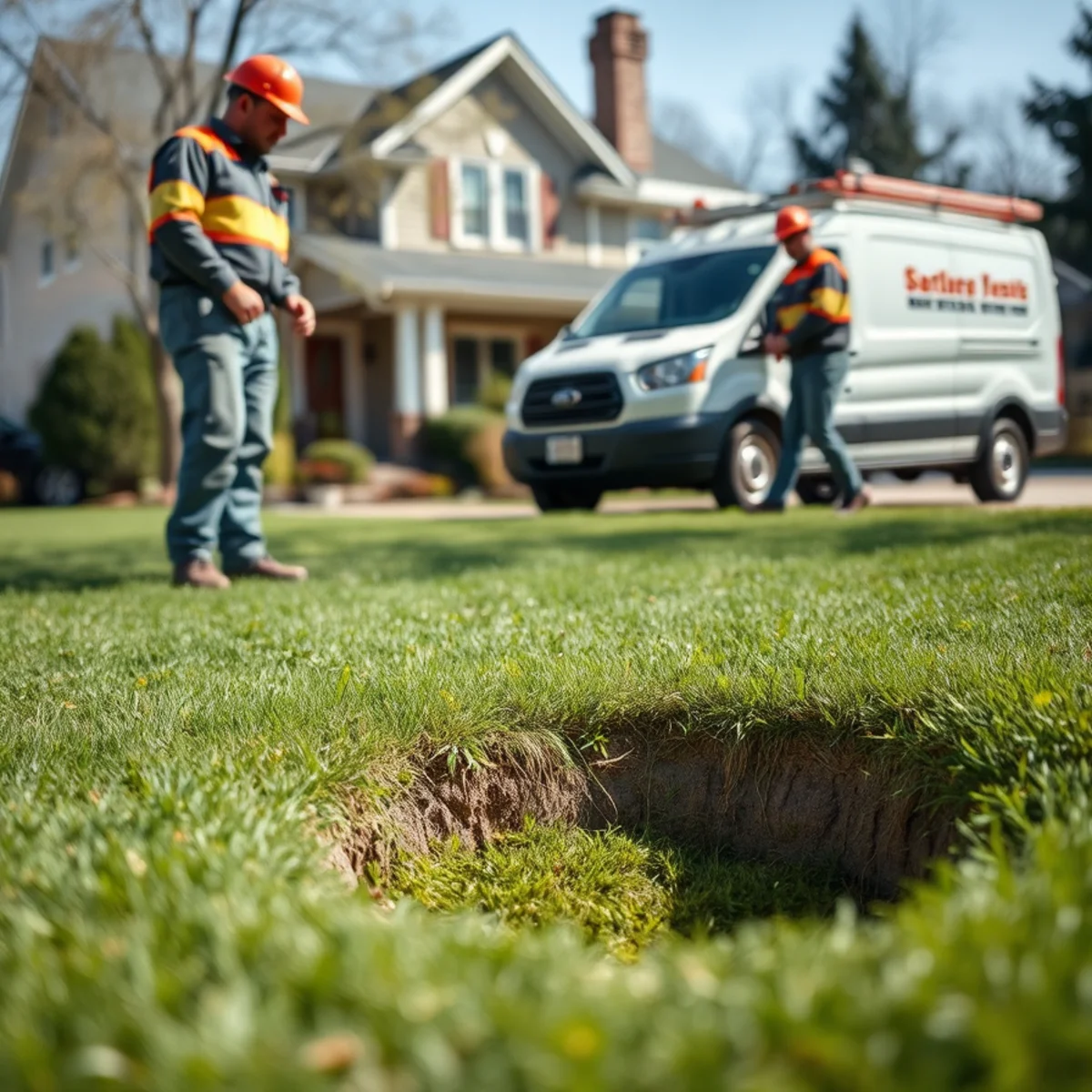
- A soft spot, dip, or small sinkhole in the yard along the line's path
- An unusually lush or dark green strip of grass tracking from the house toward the street
- Clogs that come back within weeks of being snaked
Why a Camera Catches It Before It Becomes a Collapse
Snaking clears a blockage but tells you nothing about the pipe itself. A collapsed or broken pipe inspection puts a camera directly inside the line, so a technician can see an offset joint, a hairline crack, or a root mass exactly where it sits — not guess at it from symptoms upstairs. If roots are the recurring issue, a dedicated tree root intrusion inspection documents how far the roots have spread and whether they're isolated to one joint or several.
Paired with a locator transmitter in the camera head, we can mark the precise depth and surface location of any defect. That means if repair is needed, the excavation is targeted to a few feet of pipe instead of an open question mark running the length of the yard.
What Happens During an Inspection
- We access the line through an existing cleanout or a fixture connection
- A self-leveling camera head is fed through the pipe on a distance-counted cable
- Live video is recorded the entire length of the lateral
- A locator signal from the camera head is traced from the surface to mark any defect's exact position and depth
Early detection changes the outcome
A joint that's beginning to separate can often be addressed with a targeted repair or spot lining. Left alone, that same joint can progress to a full offset or collapse that requires a much larger excavation. The difference is usually a matter of years, not decades.
Clay vs. Other Pipe Materials: What We Find Underground
Clay isn't the only lateral material we run into across these older neighborhoods. Knowing what's actually in the ground changes what kind of failure to expect.
Material-by-material failure patterns
- Vitrified clay (most common pre-1970s) — fails at the joints first: mortar or oakum seals dry out, shift, and let roots and soil in, while the pipe segments themselves are often still structurally sound
- Cast iron (common near foundations and in some full runs) — fails from the inside out as corrosion thins the pipe wall, eventually creating holes or full-circumference breaks rather than joint gaps
- Orangeburg / bituminous fiber (occasional in 1940s–1960s homes) — deforms under soil pressure over time, going oval or blistering internally rather than cracking cleanly, and is notoriously easy to damage further by snaking
- PVC (modern replacements and newer construction) — rarely fails from age alone within a normal service life; problems here usually trace to a bad joint connection or installation damage rather than material fatigue
A Worked Example: 1940s Bungalow on Detroit's East Side
Consider a 1940s bungalow on Detroit's east side, a few blocks from a mature street tree canopy planted the same decade the house was built. The homeowner has snaked a recurring kitchen and basement backup twice in eight months. A camera inspection finds two separate issues: a root mass at a joint 25 feet out, and a second joint another 15 feet beyond it that's already offset by nearly half an inch.
Because both defects sit within a 20-foot stretch, the more cost-effective fix is a single trenchless lining section covering that whole run rather than two separate spot repairs — landing in the $500–$975 length tier rather than paying for two individual point repairs that would likely add up to more. Without the camera footage showing both defects together, that decision would have been a guess.
Common Mistakes Homeowners Make With Aging Clay Lines
- Assuming a home inspection during purchase already covered the sewer lateral — most general home inspections don't scope the line at all; see our real estate sewer inspection guide for what's actually checked
- Cutting roots on a recurring schedule without ever addressing the joint gap that let them in, which manages the symptom indefinitely instead of stopping new growth
- Planting new trees or large shrubs directly above a known clay lateral route, which restarts the root-intrusion clock
- Skipping a locate before any yard work or excavation near a suspected defect, risking damage to a line that hasn't even been repaired yet — a sewer line locating pass marks the exact path first
The same math applies just up the road in Eastpointe, where similar postwar construction runs on the same era of clay pipe.
Not Just an Old-House Problem
Homeowners sometimes assume a clay lateral is fine as long as the house itself has been updated — a new roof, new windows, a remodeled kitchen. None of that touches what's buried in the yard. We've inspected plenty of thoroughly renovated homes in Warren and Detroit where the original clay lateral was never part of the conversation, simply because it's invisible until it causes a problem. It's also common to find a home with a mix of materials — clay in the yard, a cast iron stub near the foundation, maybe a PVC repair section from a previous fix — and each transition point between materials is its own potential weak spot worth checking.
What Repair Looks Like Once a Defect Is Found
Not every clay line defect means a full excavation. What the camera finds determines the scope:
- A single offset joint or small root intrusion — often addressed with a spot repair or a short trenchless lining section
- Multiple joints showing wear along one stretch — may call for lining a longer run of the pipe without full excavation
- A collapsed section or extensive fracturing — typically requires open excavation and replacement of that segment
The point of the inspection isn't to sell you a full replacement by default — it's to show you exactly how much of the line is actually affected, so the repair matches the real scope of the problem.
How We Decide Between Monitoring, a Spot Repair, and Full Replacement
Not every defect we find needs the same response, and the decision isn't arbitrary.
- Measure how many joints or feet of pipe show wear, not just whether a defect exists at all
- Check whether root intrusion or an offset is isolated to one joint or has spread across several in the same stretch
- Factor in the pipe's remaining wall condition — a joint gap in otherwise sound clay behaves differently than the same gap in pipe that's already spalling
- Weigh a monitoring interval against a repair — an isolated, minor gap with no active leak may only need a follow-up check in a year or two rather than immediate work
- Match the repair method to the scope — a single joint often calls for a spot repair, while several joints in one run usually favors a longer trenchless lining pass instead of multiple separate digs
A Second Worked Example: 1930s Foursquare in Eastpointe
Contrast that with a 1930s foursquare in Eastpointe, inspected ahead of a sale rather than after a backup. No one in the household had reported a clog, an odor, or a lawn sign — the seller ordered the inspection because the home's age made a clean bill of health worth confirming before listing.
The camera found something more distributed than a single defect: three separate joints across a 35-foot stretch, each offset by a small but measurable amount, consistent with decades of slow soil movement rather than one acute event. None was severe enough to justify emergency repair, but together they represented a lateral clearly approaching the end of its useful life.
Because the defects were spread across a longer run rather than isolated to one spot, lining that entire stretch in a single pass made more sense than three separate point repairs, and gave the seller a clear, documented number to negotiate with instead of an open-ended unknown hanging over the transaction. This is exactly the scenario a real estate sewer inspection is built for — catching a slow-motion problem before it becomes the buyer's surprise.
What to Ask Your Inspector About a Clay Lateral
Questions worth asking
- How many joints or defects did you find, and are they isolated or spread across a longer run?
- Is this section actively leaking, or is it a gap that hasn't caused a symptom yet?
- If we wait, what's a reasonable timeline before this needs a repair?
- Would a spot repair or a full lining section better fit what you found, and why?
- Can I get the footage and location report in writing for my own records or a future sale?
Myths vs. Facts About Clay Sewer Pipe
- Myth: Clay pipe is always the worst material you can have. Fact: Sound, undisturbed clay pipe with intact joints can last decades longer — age matters less than joint condition.
- Myth: If one joint has failed, the whole line needs replacing. Fact: A single isolated defect is often a candidate for a spot repair; full replacement is usually reserved for multiple failure points or a collapsed section.
- Myth: Root intrusion means the tree caused irreversible damage. Fact: Roots exploit an existing gap — repairing the joint and clearing the roots typically resolves it, though nearby trees deserve ongoing monitoring.
- Myth: A home with a finished basement and no odor can't have a clay pipe problem. Fact: Odor and basement moisture are downstream symptoms; a slow leak into unfinished soil outside the foundation can go undetected for years.
Freeze-Thaw Season: Why Clay Joint Failures Cluster in Spring
Clay joint failures across Metro Detroit aren't evenly distributed through the year — they cluster in late winter and early spring. In older, densely built communities like Hamtramck, where lot lines run close together and laterals are often shallow and decades old, the freeze-thaw cycle acts almost like a stress test on every joint each winter.
As the ground freezes, soil expands and can lift or shift a shallow lateral slightly out of position. When it thaws, the ground settles back down, but not always to the exact same alignment — and each freeze-thaw cycle repeats that small stress on the same joints, year after year, until one finally opens enough to let roots or soil in. That's why we see a noticeable uptick in clay-related service calls every March and April across these older, tightly built neighborhoods.
Related Reading Before You Decide on a Repair
If you're trying to decide what to do next with an aging clay lateral, a few of our other guides go deeper on specific angles. Our sewer line maintenance checklist for older homes lays out a full preventive schedule. If you're specifically in Macomb County, our guide to older-home sewer inspections in Macomb County covers local housing stock in more detail. And if locating the exact path of a suspected clay run is your next step before any yard work, how sewer line locating works explains the process. Clay also isn't the only aging pipe buried under Metro Detroit homes: postwar subdivisions often hide Orangeburg sewer pipe, and homes with metal drains should know the signs of cast iron sewer pipe corrosion.
When to Schedule One
If your home is over 50 years old, you're dealing with recurring clogs, you're buying a house with an original clay lateral, or you've already had one backup, it's worth getting eyes on the line rather than waiting for the next symptom. For a broader rundown of what to watch for, see our guide to warning signs of sewer line failure.
Concerned about an older clay lateral in Warren or Detroit? Sewer Inspects offers free quotes on sewer camera inspection — call (614) 830-0578 to schedule and get a clear look at your line before a small problem becomes a big one.
Need a sewer camera inspection?
Same-day appointments across Sterling Heights, Macomb County & Metro Detroit. Free quote, no obligation.